

The clear majority of American Jews who identify religiously, and are members of synagogues are directly or indirectly affiliated with the major Reform, Conservative, and Orthodox (Modern- or Centrist-Orthodox, or Ḥaredi [sectarian or “ultra-Orthodox”]) denominations. These movements all have their ideological—and to some extent institutional—roots in Europe in the 19th century. Reconstructionism,[1] the youngest and the only native American movement in Jewish religious life, is institutionally statistically miniscule in comparison.
In 1970 the late sociologist and political scientist Charles Liebman wrote a major study, “Reconstructionism in American Jewish Life,”[2] seeking “to show why, when so many American Jews are reconstructionists, so few are Reconstructionists.”[3] Despite its miniscule institutional membership, Reconstructionism had become the pervasive, albeit largely unconscious ideology among non-Orthodox Jews, and in some ways even had its effect on the modern (or “centrist”) elements among the Orthodox. Part IV of Liebman’s study is called “Reconstructionism as the Ideology of American Judaism.” If anything, that observation—reconstructionist, but not Reconstructionist—is all the more accurate today, over half a century later.
This paradoxical phenomenon is directly due to one person—Rabbi Mordecai M. Kaplan (1881–1983). Although born in Lithuania, he came to America as a child in 1889. He entered the preparatory program of the (Conservative) Jewish Theological Seminary in 1893, where he was ordained as a rabbi in 1902 (he received a second, traditional rabbinic ordination in 1908), and received a B.A. from the City College of New York in 1900 and an M.A. from Columbia University in 1905. He joined the faculty of J.T.S. in 1909, where he continued to teach (with a few interruptions when he was in Jerusalem) until his retirement in 1963.
So, for over half a century all Conservative rabbis were exposed to Kaplan’s teaching and ideology at J.T.S. Through his influence on them, his ideas spread to their congregations. For years Kaplan rejected attempts to establish Reconstructionism institutionally as a fourth denomination, preferring for it to remain as an ideology permeating the other movements, and it was only in 1968 that the Reconstructionist Rabbinical College was founded (and initially headed by Kaplan’s son-in-law—his eldest daughter Judith’s husband—Ira Eisenstein).
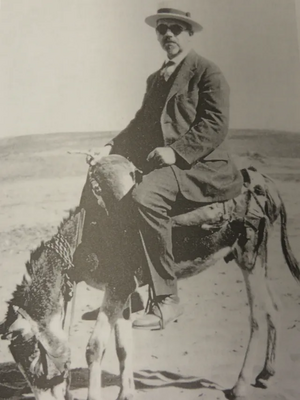 PHOTO LEFT: This photograph of Mordecai Kaplan on a donkey in British Mandatory Palestine was taken in 1925. Kaplan came to represent the Zionist Organization of America at the opening ceremonies of the Hebrew University Jerusalem. (The photograph appears on p. 203 of Volume One of Communings of the Spirit, Mel Scult’s first volume of Kaplan’s diaries.
Among the most pervasive of Kaplan’s ideas were his advocacy of “the Jewish Center” (for educational, cultural, and social functions, not just a synagogue for prayer and study), and egalitarianism (his daughter Judith [1909–1996] celebrated becoming bat mitzvah in 1922 at Kaplan’s Society for the Advancement of Judaism). The “Jewish Center” concept spread widely, and bat mitzvah ceremonies for girls—often but not necessarily involving being called to the Torah—became widespread, more recently even in modern Orthodox circles and in Israel. Full egalitarianism became prominent only decades later, more or less beginning in the 1960s–1970s. Today, women are routinely ordained as rabbis in Reform and Conservative (Masorti), and non-denominational rabbinical seminaries, and there are traditional seminaries training women to be rabbis (at least in a functional sense, although some prefer terms other than “rabbi”).
However, perhaps the most important contribution Kaplan made was his placing affirmation of, and loyalty to “Jewish peoplehood”—not theological affirmation—at the heart of Jewish identity. Judaism, as he famously defined it in his pioneering book Judaism as a Civilization (1934) is the evolving civilization of the Jewish people, consisting of three organically inter-related components: peoplehood, culture, and religion.
Many American Jews knowingly, or unknowingly subscribe to that formula without accepting Kaplan’s radical religious ideas—notably his rejection of supernatural belief in a personal God, and his rejection of the traditional concept of the Chosen People (and changing the liturgy accordingly). They can identify with their ethnic and cultural heritage encapsulated by the term “peoplehood,” without necessarily following the religious component of Jewish identity if they are inherently secular, or they can accept Kaplan’s emphasis on peoplehood while remaining personally religiously traditional in outlook, belief, and practice.
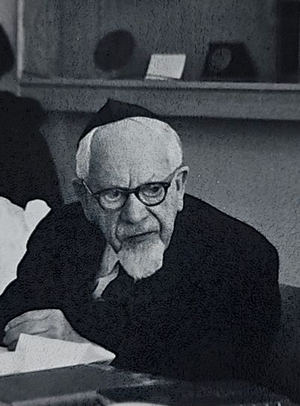
Kaplan lecturing at Brandeis University, academic year 1969–1969 (?)
Photo by Raphael Jospe.
The primacy of identifying with “Jewish peoplehood” as opposed to theological affirmation is a consistent theme in many of Kaplan’s voluminous writings. On a personal note: it is perhaps best epitomized in what Kaplan wrote me in a hand-written, personal letter (when I was a second-year undergraduate student at Brandeis University): “In Judaism as a civilization, ‘belonging is prior to believing’ although meaningless without ‘believing’.”[4]
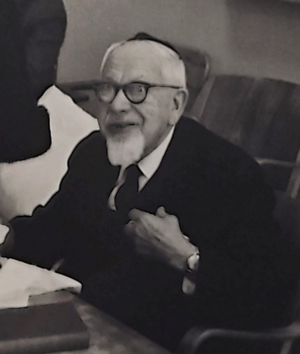
Kaplan lecturing at Brandeis University, academic year 1969–1969 (?)
Photo by Raphael Jospe.
Kaplan’s commitment to the primacy Jewish peoplehood in all its diverse forms—together with his life-long belief in democracy and pluralism—also underlay another letter that may not appear in his own published works, but is worthy of note. In the late 1950s, the Prime Minister of Israel, David Ben-Gurion, faced a political crisis (which has never been resolved to this day): the official State Population Registry of Israeli citizens includes two categories: nationality (le’om) and religion (dat).
What should be done in the case of the child of a mixed marriage in which the mother is not Jewish (since Jewish identity traditionally follows the mother)?[5] Can there be a Jewish nationality separate from Jewish religion? Is conversion (giyyur) only to be recognized by the State if it accords with the strictly Orthodox standards of the established Orthodox State rabbinate? In turn, how do these questions impact on the “Right of Return” that all Jews have to immigrate to Israel and receive citizenship? More fundamentally: how is all this compatible with the commitment in Israel’s Declaration of Independence that the State of Israel will guarantee freedom of conscience and religion, and equality before the law? In an official letter dated 13 Ḥeshvan 5719 / 27 October 1958, Ben-Gurion wrote to 43 “Sages” in Israel and abroad—rabbis, academics, intellectuals across the ideological spectrum—requesting their views.[6]
In his detailed reply to Prime Minister Ben-Gurion dated 20 Kislev 5719 (Kaplan only listed the Hebrew date, which was equivalent to 2 December 1958), Kaplan wrote:
1) The assumption that there is indeed a “tradition accepted by all Jewish spheres, secularists, in all their factions and Orthodox Jews alike” is ill-founded, having a basis neither in theory, nor in experience.
2) The very fact that the Government has given the Rabbinate the authority to compel all Jews to accept its jurisdiction in marital affairs … constitutes a denial of the supposition that Israel ‘guarantees the freedom of conscience and religion.’
***
Were it not for the Zionist movement, we should have forgotten that we are a member of one nation and our ancestors were once “one people in the land.”
In short, our commitment to a common Jewish peoplehood cannot violate our commitment to democratic pluralism.
Kaplan’s many published books and articles total thousands of pages. Yet, despite his propensity for prolific writing, Kaplan also had a knack for a pithy phrase, perhaps the most famous of which is: “Tradition deserves a vote but not a veto.”
It turns out that Kaplan’s many published writings are, in a sense, only the tip of the iceberg. The published works gave rise to an image held by many of his readers of Kaplan as coldly rational. That image of Kaplan is belied by what we now know (besides personal testimony of various of his students), thanks to Mel Scult’s thorough and meticulous research on Kaplan. Scult—now 92 and a retired professor at C.U.N.Y. / Brooklyn College—has been researching Kaplan’s thought and writings (including interviews with Kaplan himself) for half a century. His extensively documented Judaism Faces the Twentieth Century: A Biography of Mordecai M. Kaplan came out in 1993.[7] (Scult’s own biography notes that he was born on May 28, 1934, paradoxically the same day Kaplan’s pioneering Judaism as a Civilization appeared).
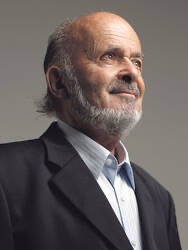
Mel Scult
Scult has had unprecedented access to Kaplan’s voluminous diaries, totaling tens of thousands of pages. He has edited and published three volumes of annotated selections: Communings of the Spirit: The Journals of Mordecai M. Kaplan.[8] Volume One (2001) covers 1913–1934; Volume Two (2016) covers 1934–1941; Volume Three (2020) covers 1942–1951. Together the three volumes come to some 1500 pages. The ongoing project will now be continued by younger hands.
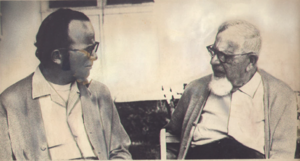
Mel Scult with Kaplan.
The diaries show different sides of Kaplan, including sentimental poetry and religious sensitivity, also expressions of personal frustration and anger at the events—personal, professional, political—of that day. The references—whether to personal encounters or to reactions to books Kaplan read—are a virtual “who’s who” of intellectual, religious, and political figures, Jewish and non-Jewish alike.
What Scult has now done is to prepare a volume, The Religious Humanism of Mordecai Kaplan: An Anthology, in which he has presented in thematic order citations gleaned from the huge volume of Kaplan’s published works and the diaries published to date. This will greatly facilitate handy reference to what Kaplan had to say on a wide variety of topics, with Scult’s notes and comments, including information about the sources and events to which Kaplan frequently reacted over his many decades of activity.
In Scult’s words:
My method is this: in the many years of my study of Kaplan, I have saved outstanding passages, powerful passages, elegant passages, lovely passages, passages that spoke to me and that best illustrate his thought. In each case, I have commented on these passages giving them a context, and exploring their meaning and relevance. In preparing this work, I have divided the passages by subject matter to make them more usable. So, we have here chapters on God, ethics, prayer etc.
***
I might say that this volume will also be valuable to those familiar with Kaplan, and to any person who studies religion, to any person who teaches religion and includes Kaplan, and to the rabbis and laymen who teach him in schools, colleges and congregations.”
***
In his last years, Kaplan hoped and prayed for the unity of the Jewish people. To bring that about he mentioned an anthology which would inspire all toward a greater commonality. This book is a pledge toward that unity.
The Table of Contents provides a handy guide for the reader to find a particular theme of interest:
Forward
Introduction –Summary of Kaplan’s Thought.
The CategoriesPart I Judaism and Peoplehood
Chapter 1. Civilization, Peoplehood and Zionism
Chapter 2. Democratic Values
Chapter 3. Ethics, Social Justice and CommunityPart II. Judaism as Spiritual Practice
Chapter 4. God and Spirituality
Chapter 5. Torah and Ritual
Chapter 6. PrayerPart III. Kaplan on Kaplan and Famous Others
Sources. [ for the Selections above.]
An Annotated bibliography: This list includes a selection of Kaplan works, books about Kaplan,
articles about his thought and his life, a guide to archival sources, works by disciples and
scholarly essays.
Index
Throughout the book, Scult succinctly and precisely summarizes Kaplan’s lengthy views on a wide variety of subjects. A few examples will suffice:[9]
Kaplan is famous for dismissing traditional supernaturalism and yet as his prayerbook attests he was comfortable with using God language. As he once put it in an article in the thirties, “Humanism is not enough.”
In a letter (1904?) to Phineas Israeli, Kaplan wrote of his indebtedness to, but difference from, the Zionist thinker and Hebrew essayist Aḥad Ha-Am (Asher Zvi Ginsberg; 1856–1927), for whom the spirit of a nation is expressed in its culture, and for whom a Jewish State was important to provide a healthy body for a healthy spirit:
You identify me too much with Ahad Ha Am. I grant you that I drew my first inspiration from him, but I went much further than he did. His nationalism is a barren unproductive idea. I have converted it into a fruitful idea giving it religious significance. Thus, with me the nationality of Israel is the best proof of the divine government in human history.
Scult then observes:
In this light, Zionism was not simply a project of state-building, Kaplan believed, but a means to revitalize the Jewish people, wherever they lived, by reconnecting them to the unfolding drama of their civilization. Kaplan was a pluralist and believed in the vitality of Jewish centers outside Israel.
Kaplan’s consistent and life-long Zionism was thus deeply influenced by the writings of Aḥad Ha-Am, although Aḥad Ha-Am’s “cultural Zionism” lacked the religious component so important to Kaplan.[10]
However, as we have seen in Kaplan’s response to David Ben-Gurion that the Zionist vision and commitment must be fully democratic; democracy, for Kaplan, is not merely a political arrangement, but a sacred value. In Scult’s words in Chapter Two: Democratic Values:
For Kaplan, democracy was not merely political but ethical as well. His concept of Jewish civilization centered on democracy. He had always read John Dewey[11] and was able to draw on Dewey’s commitment to democracy. For Dewey and for Kaplan, democracy meant the sacredness of individuality and the centrality of growth in all activities. Though, of course Kaplan was committed to the Jewish people, yet he was at the same time a universalist. Throughout his work, we see a profound concern with all people. He wanted Jews to view their fate as tied up with the fate of all people.
He employed the concept of salvation in combining his concern for the individual and his deep religiosity. His concerns for the welfare of every person, also led him to an early acceptance of democratic socialism. In addition, he was an early advocate of what we have come to call “civil religion” believing that American life with its national holidays expressed both universal and Jewish values. Thus, one might say he lived in two civilizations.
Scult also finds the way to epitomize in a few lines Kaplan’s complex views on God, according to which God is not a “being,” but a “function” or “process” (like the term “teacher” signifying not a being, but a function):
Most of us tend to “thingify” and make God into an entity or a person. For Kaplan, it is a process that he is referring to here which is an extension of our urge to become fully what we are. That ideal is the essence of divinity for Kaplan.
“Our conception of God (i.e. of his nature) depends upon what we regard as the source of man’s belief in God. Traditionalists assume that God has revealed himself to man. Positivists assume that man has made God in his own image. The truth is that man has discovered God. If we believe that God has revealed himself, we conceive of God as a supernatural entity. If we believe that man makes God in his own image, we negate the existence of any reality independently of our idea. If we assume that man gradually discovers God, we regard God as an objective reality. The discovery that God is a process which goes on in the universe and which insofar as it involves man makes for the progressive realization of his creative potentialities.”
In such a scheme, “salvation” is no longer understood in other-worldly terms, but as personal and collective self-fulfillment. Here, again, then, Kaplan’s religious outlook and commitment to democracy coalesce:
“When a person deifies himself [herself][12]—we get tyranny.
When a nation deifies itself—we get chauvinism.
When a class deifies itself—we get totalitarianism.
When a church deifies itself—we get clericalism.
All these are forms of idolatry.”
In conclusion, The Religious Humanism of Mordecai M. Kaplan: An Anthology is a valuable and useful resource for anyone interested in learning about Kaplan’s unparalleled analysis of, and contribution to contemporary Jewish life, primarily, but by no means exclusively in America.
As such, the book provides an easily accessible guide to Kaplan’s thought in systematic order, gleaning insights that might have been overlooked even by those who have read Kaplan’s many published works and Scult’s editions of the diaries, given the huge quantity and length of those books. Yes, there are other biographies[13] and anthologies, but Scult’s contribution is unique.
Even in Israel, which obviously differs radically from the American experience, there are growing efforts among the so-called “secular” Jews to find creative outlets for some kind of spiritual/religious expression and alternatives to the increasingly strident, stringent and extremist “Religious Zionist” Orthodox and “Ḥaredi” ultra-Orthodox political establishment.
Most of these searchers have never heard of Kaplan, and only three of his many books have been translated into Hebrew. On top of which the explicitly American context of most of Kaplan’s works (e.g. The Future of the American Jew, 1948) are not directly pertinent to the contemporary Israeli experience. Nevertheless, his rejection of supernaturalism (in favor of what he called “trans-naturalism”), and his central notion that the sancta of Jewish civilization can and should be “revalued” and thereby retained (even if their meaning has been reinterpreted and redefined) are insights that are being applied—whether consciously or unconsciously—among these small, tentative, but growing experiments in Israeli life.
Whether or not one agrees with Kaplan in general, or on specific points (and, as mentioned, in my Accepting and Excepting: Pluralism and Chosenness Out of the Sources of Judaism[14] I explicitly adopt Kaplan’s method to reject some of his conclusions), Kaplan’s thought in many respects can serve as a lodestone for reinterpreting—and thus reaffirming—Jewish religious identity for those who cannot intellectually affirm various traditional beliefs, certainly not in a literal sense. But as a friend and colleague (and classmate of mine over half a century ago) has put it: Even if we cannot take certain traditional teachings or texts literally, we can still take them seriously.