

From 12 to 15 July, Jews and Christians from across the world, along with some Muslim participants, met in Hanover for the 2026 International Conference of the International Council of Christians and Jews (ICCJ). It was co-hosted with the German Coordinating Council of Societies for Christian-Jewish Cooperation (DKR).
The theme, "Repentance, Repair and Reconciliation: Religious Resources for Tumultuous Times," was chosen before the latest war in the Middle East. It only grew more fitting as the months went on. The aftermath of 7 October 2023 has strained dialogue groups and friendships everywhere, and nobody in Hanover pretended otherwise. Yet the strongest memory for many will be the spirit of the gathering, which was warm, candid and full of hope.
Rabbi Dr David Meyer set the tone as he received the Seelisberg Prize, with a keynote titled "Beware of Soothing Words" (Isaiah 30:10). The plenaries then followed a clear path. They began with vocabulary (who can repent, and who can forgive?), moved through liturgical, ethical and practical approaches, and ended by asking whether "repair" is enough in the face of ecological and planetary harm.
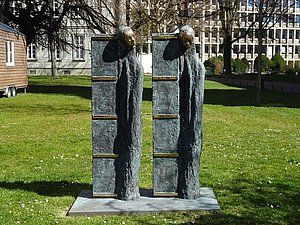 The workshops covered just as much ground: dialogue under pressure over Israel-Palestine, Christian Zionism, the reckoning with Christian complicity (from postwar Germany to Walter Grundmann's "Dejudaisation Institute"), illiberalism and religious nationalism, and antisemitism on campus. Others drew on Scripture and liturgy, including Scriptural Reasoning on teshuvah, metanoia and tawba, or tried new media such as podcasting, film and popular culture. Over all of it stood Johan Tahon's sculpture Twins, outside the regional Lutheran church office (Photo left). It reworks the old Ecclesia and Synagoga motif, which Christian art long used to demean Judaism, so that neither figure can be clearly identified as Church or Synagogue.
Canadians took a visible part. Fr Geoffrey Ready spoke in the second plenary, on liturgical approaches, with Ruth Langer, Anne Marie Reijnen, Katarzyna Kowalska and Engin Karahan. He described the Orthodox understanding of repentance as healing (metanoia) rather than a legal verdict. He pointed to the Rite of Forgiveness at the threshold of Lent, where worshippers bow to one another and ask forgiveness even of strangers. He also spoke of "involuntary sin," the Orthodox idea that we answer for harms we never knowingly or directly caused. He confessed a "holy envy" of the Yom Kippur Vidui, whose plural "we have sinned" gives a community a corporate voice that Orthodoxy finds harder to reach.
With Rabbi Shoshana Boyd Gelfand, he then led the workshop "Who Speaks for Us?" It asked how dialogue works between two traditions that have no pope or chief rabbi. Fr Geoffrey spoke frankly about young converts formed by online versions of Orthodoxy, some of which carry antisemitism with them. He argued that the decentralisation which lets a tradition be misrepresented is the same freedom that lets it be received more deeply, "wound and gift in a single motion." Participants then shared, in twos and threes, their own experiences of being spoken for.
Héctor Acero Ferrer (Institute for Christian Studies and Martin Luther University College) moderated the closing plenary on ecological responsibility. With Mia Theocharis (St Michael's College [Toronto] and Hillel Ontario), he also led a workshop on antisemitism in university life. Rabbi Shaul Osadchey, a former president of the Calgary Council of Christians and Jews, led a workshop on building religious literacy in congregations.
Midway through the conference, participants travelled to the memorial at the former Bergen-Belsen concentration camp, where tens of thousands of Jews and others died. After two days of talking about repentance and repair, standing together on that ground was a sobering reminder of what those words must answer for, and of why this work began in the first place.
Above all, Hanover was a reminder that dialogue lives in relationships. Many of those relationships were renewed over meals and in corridor conversations, some after long silences brought on by the past two years. The ICCJ's annual meeting confirmed that Canada is due to host the international conference in 2028. It will be our turn to welcome the world, and to carry forward the hope that Hanover so clearly showed.